Reading aloud when your child has plenty to say
“It’s a mouse!” You’re one paragraph in. Ghurt has just found a stripy sock, and he certainly hasn’t worked out why it keeps moving. Your child, meanwhile, has an excellent theory about what’s under the sofa. What can you say without giving the game away?
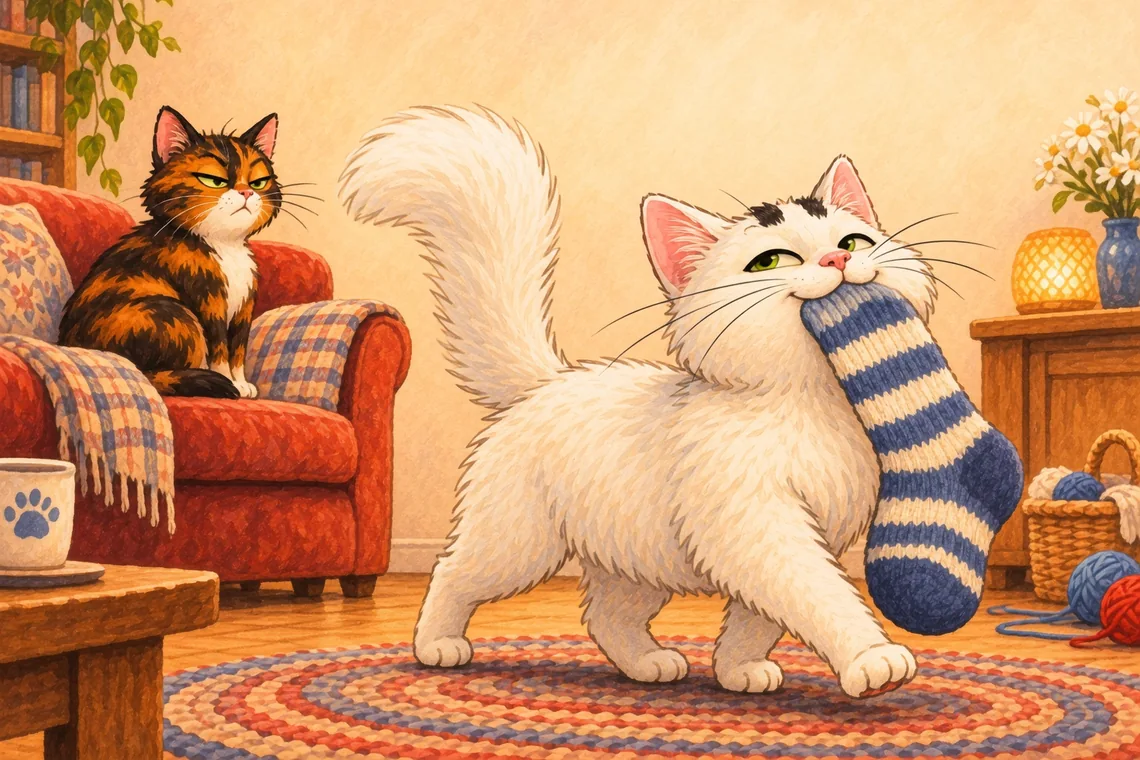
“I know what’s doing it!”
Try a whisper. “A mouse under the sofa? Shall we keep that between ourselves for a minute?” Now you and your child share a secret, and poor Ghurt can get on with turning round and round in his basket.
Your child might have a completely different theory. Perhaps the sock wants to sleep next to Mispoes. There’s room for that idea too. “Where’s it got to now? Can you see the little bit of yellow?” Let the next page do the talking.
“I’ve got a sock like that!”
Suddenly you’re talking about the sock that went missing at swimming. Keep your thumb on the line. Sometimes all you need to say is “The one with the shark on the heel?” When you’re ready, pick up with the same words you just read: “A bit of yellow was poking out from under the sofa.”
If one pyjama-clad leg is already halfway to the sock drawer, you might decide you’d both rather see the shark. Ghurt will still be under that red sofa tomorrow.
Give the sock a speaking part
If your child knows the story, you can play Ghurt and give them the part of the sock. It has precisely one line: “Zip!” Read “This time he only turned round once.” Then wait. If the zip comes three beats early, Ghurt can sound all the more surprised.
For the last joke, let your child be Mispoes and ask how many feet that sock has now. Slip two fingers into a real sock for Ghurt’s answer. You may find the fingers can finish the story all by themselves.